Beauty Tech Devices Over 50: Are They Worth It? What the Research Actually Shows
The honest, evidence based breakdown of LED masks, microcurrent devices, and radiofrequency tools, from someone who actually uses all three.
By Amy Shorrosh, Certified Makeup Artist and Founder, Beauty With AS
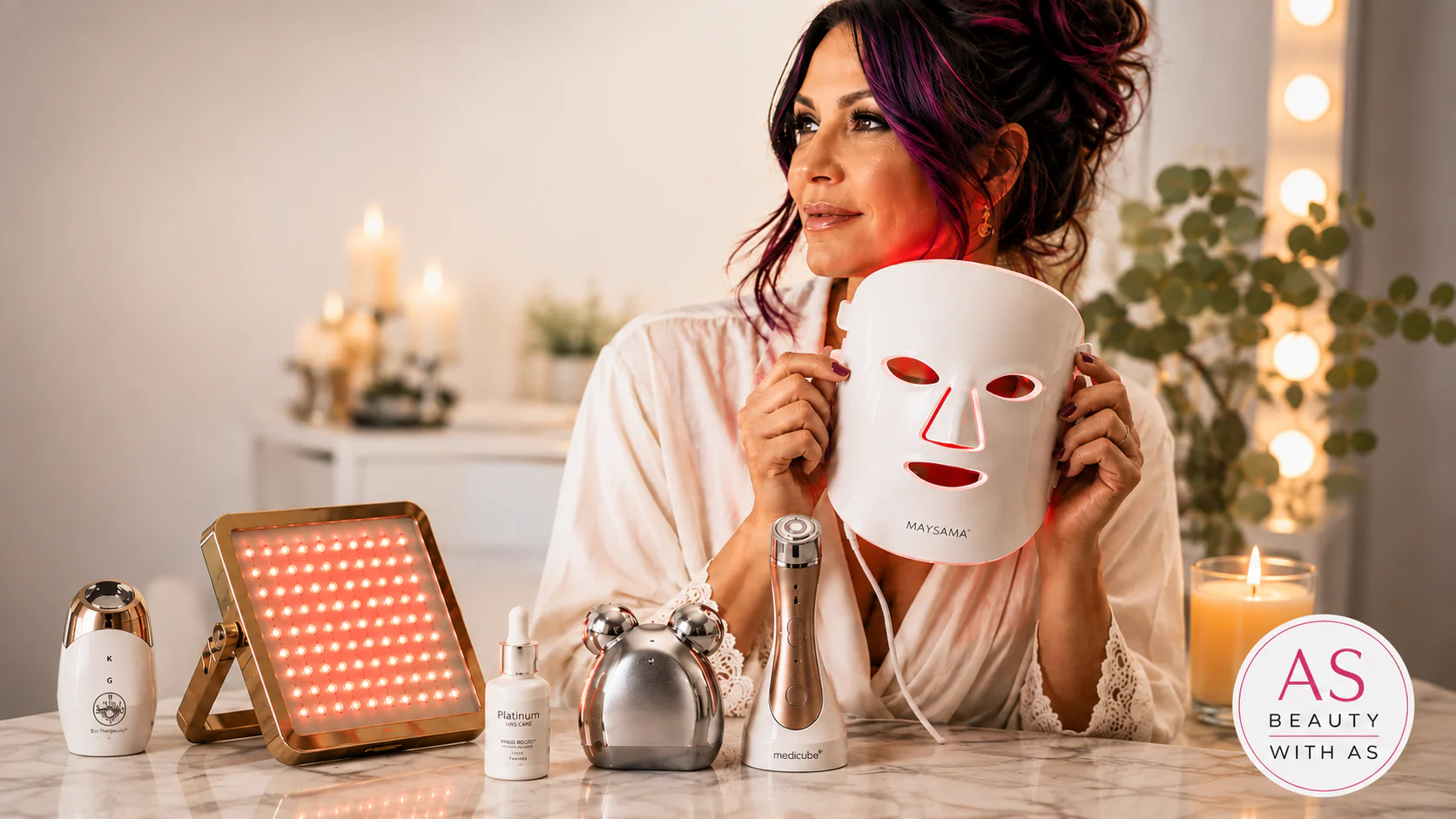
When it comes to beauty tech devices over 50, I use my LED mask like clockwork. Five days a week, twenty minutes, no exceptions, it is basically part of my morning routine at this point. But my microcurrent device? It has been sitting on my bathroom counter for the better part of a year. I pick it up, use it twice, then let it collect dust while I tell myself I will “start again Monday.”
Meanwhile, a friend of mine will not stop texting me about her microcurrent device. She swears it “changed her jawline in two weeks.” So I have been sitting here wondering if I wasted money on mine, or if I just gave up before it had a real chance to work.
Here is the direct answer, because you deserve one before you keep reading: some beauty tech has real, published research behind it. LED light therapy has the strongest evidence. Microcurrent and radiofrequency have decent but more modest support, and both depend heavily on consistent use. A good chunk of what gets marketed to us, jade rollers, vibrating “detox” brushes, anything promising instant collagen, has close to none. The difference almost never comes down to the device itself. It comes down to evidence, mechanism, and whether you are honest with yourself about your own follow through.
Let’s get into it. If you need a calmer starting place, begin with a simple post-menopause skincare routine before adding more devices.
🩷 QUICK ANSWER
If you’re deciding whether beauty technology is worth the investment after 50, here’s the short version:
✔ LED light therapy has the strongest scientific evidence.
✔ Microcurrent works—but only if you’ll actually use it consistently.
✔ Radiofrequency can provide modest tightening with realistic expectations.
✔ Skip gadgets promising instant collagen or “detox.”
✔ The best beauty device is the one you’ll actually use every week.
What the Science Actually
Yes, but only some of them. Current clinical research shows that LED light therapy has the strongest evidence for improving collagen production, skin texture, and fine lines. Microcurrent and radiofrequency devices can also provide benefits, but they require consistent long-term use and generally produce more modest results than professional treatments. The best beauty device isn’t necessarily the most expensive, it’s the one backed by evidence and realistic enough for you to use consistently.
Key Takeaways
| Device | Research Support | Best For | Time to Results | Worth Buying? |
|---|---|---|---|---|
| LED Light Therapy | ★★★★★ | Fine lines, collagen, redness | 8–12 weeks | ✔ Highly Recommended |
| Microcurrent | ★★★★☆ | Temporary lifting & toning | Immediate + ongoing maintenance | ✔ If you'll use it consistently |
| Radiofrequency | ★★★☆☆ | Mild skin tightening | 6–12 weeks | ✔ Moderate Recommendation |
| EMS Facial Devices | ★★☆☆☆ | Muscle stimulation | Temporary | Maybe |
| Jade Roller | ★☆☆☆☆ | Puffiness | Immediate | Not for anti-aging |
| Vibrating "Detox" Devices | ★☆☆☆☆ | Little supporting evidence | N/A | Skip |
Bottom line: If you’re only investing in one beauty device after 50, current research suggests an LED light therapy device offers the strongest combination of scientific evidence, ease of use, and long-term value.
- LED light therapy, particularly red light, has the strongest clinical evidence of any at home beauty device, with measurable collagen and texture improvements after 8 to 12 weeks of consistent use.
- Microcurrent devices have real but more modest support. Expect temporary muscle toning that fades within a few days unless you keep using the device regularly.
- At home radiofrequency devices can support mild skin tightening over time, but they are intentionally diluted compared to in office treatments, and no study has directly compared the two head to head.
- Jade rollers, vibrating cleansing brushes marketed as “detox” tools, and anything promising instant collagen have little to no real research behind them.
- The device that works for you is the one you will actually pick up. Consistency predicts results more reliably than price tag or marketing copy.
Why We're So Skeptical, and Why That's Actually Smart
Here is what nobody tells you about being a Gen X woman navigating menopause and mature skin: we have been marketed to our entire lives, and we have gotten good at spotting a pitch. That skepticism is not cynicism. It is earned wisdom.
I spent years in corporate HR technology before I became a beauty educator, and that world taught me something that has never stopped being useful: if a product cannot explain its mechanism of action in plain language, be suspicious. Not scared. Suspicious. There is a difference.
The beauty tech industry is enormous right now, and a lot of it is genuinely useful. A lot of it is also repackaged marketing dressed up in clinical language. The trick is learning to tell the difference, especially when your skin is dealing with real changes: collagen loss, slower cell turnover, hormonal shifts that show up on your face whether you are ready or not.
The good news is some of these devices have real research behind them. The challenge is that the research does not always match the marketing claims, and companies know most of us will not read a clinical study before we click “add to cart.”
What Does the Research Say About LED, Microcurrent and Radiofrequency Devices?
Let me save you some money and some disappointment. This is where the receipts are.
LED light therapy has the most consistent clinical support of any at home device, particularly red light, for stimulating collagen and calming inflammation. In a controlled clinical study of 136 people with mild to moderate facial photoaging, participants used red and near infrared LED panels twice weekly for nine weeks. Blinded assessments found statistically significant improvements in wrinkles, skin roughness, and overall complexion compared to a sham treated control group, and biopsies confirmed an actual increase in collagen density, not just a visual impression of one. That is not a dramatic transformation. It is not going to erase twenty years in a week. But it is real, measurable change, and it depends entirely on showing up for it consistently over months, not days.
Microcurrent devices have more mixed, but still meaningful, evidence. A randomized controlled trial of 108 women who used a facial microcurrent device twenty minutes a day, five days a week, for twelve weeks found that more than 80 percent reported improved facial firming and tone, compared to fewer than 5 percent in the control group. A separate small trial found forehead wrinkles improved by roughly 18 percent immediately after treatment and stayed improved a month later. The catch is right there in the data: these are temporary effects, similar to a workout for your face, and they fade within a few days if you stop. If you are expecting a facelift in a box, you will be disappointed. If you are expecting a modest, temporary lift that requires ongoing maintenance, that is realistic.
Radiofrequency devices for home use have some support for mild skin tightening over time, though nowhere near what you would get from an in office professional treatment. In one clinical evaluation, 62 patients using a home RF device showed statistically significant improvement on a standard wrinkle and elastosis scale, as judged independently by three board certified dermatologists. That is a real result. It is also important to know there are currently no published studies directly comparing at home devices to in office ones, because home devices are deliberately built to run at lower energy for safety. Do not expect med spa results from a device you bought online for two hundred dollars, and do expect to wait six to twelve weeks before judging whether it is doing anything at all.
And then there is the stuff with almost no real evidence behind it: vibrating cleansing brushes marketed as “detox” tools, jade rollers sold as anti-aging miracles, and anything promising to “boost collagen instantly.” None of this is harmful, necessarily. It is just not going to do what the ad implies.
Why Consistency Matters More Than the Device You Buy
Here is the reframe I keep coming back to, and it is the part my clients are usually surprised by: the research tells you whether a device can work. It does not tell you whether it will work for you, because that depends entirely on whether the device fits how you actually live, not how you wish you lived.
I call this the Evidence, Mechanism, Commitment filter, or EMC for short. Evidence means published clinical studies exist, not just glowing testimonials. Mechanism means the company can explain, in plain language, why the device does what it claims. Commitment is the one nobody wants to talk about: can you honestly see yourself using this thing on the schedule the research requires, for the number of weeks the research requires, without a system to make that automatic?
My LED mask passed all three for me specifically because I built it into something I was already doing every night. My microcurrent device passed Evidence and Mechanism easily. It failed Commitment, because it requires two free hands and standing at a mirror, and that is a habit I never actually built. That is not a flaw in the device. That is a mismatch between the device and my real life, and no amount of research changes that math.
How I Choose Beauty Tech Devices Over 50 for My Own Routine
Once I named the real problem, I stopped blaming the microcurrent device and started being honest about the format I needed. I now only buy hands free tech, tools I can use while watching television or scrolling my phone, because that is when I am already sitting still. My LED mask works because it straps on and I forget about it. My radiofrequency device works because I use it for the five minutes I am already standing at the sink each morning.
For my clients, this shows up constantly. The woman who swore off “all that gadget stuff” usually was not wrong about the gadgets. She was choosing devices that demanded a kind of standing, focused, two handed ritual that never matched her actual mornings. Once we matched the device to her real routine instead of her ideal one, her results changed, not because the device got better, but because she finally used it enough to find out if it worked.
How to Actually Decide If a Beauty Device Is Worth It
- Name the specific problem you are solving. Not “anti-aging” in general, that is too vague to act on. Dullness, loss of firmness, texture changes from hormonal shifts? Get specific first.
- Look up the research, and read past the headline. A company citing “clinical studies” should be able to tell you who conducted them, how many people were involved, and whether it was independent or funded by the company itself.
- Ask the mechanism question out loud. If a salesperson or a product page cannot explain, in plain words, why the device does what it claims, that gap is information.
- Be brutally honest about your own habits. Do you already sit still somewhere for ten minutes a day? Build the device into that moment, not a new moment you hope to create.
- Choose the format that matches your real life, not your ideal one. Hands free if you are busy. Simple if you are impatient. Portable if you travel.
- Set a real trial window before judging results. Eight to twelve weeks, minimum, tracked with monthly photos in the same lighting, same angle.
- Know your walk away price. If you know yourself well enough to admit you will not use something on schedule, put that money toward a professional treatment instead, where the appointment itself creates the accountability.
Why You Can Trust This Review
Unlike many beauty technology roundups, this guide wasn’t written from a press release or affiliate brochure.
I’ve spent more than 30 years evaluating technology professionally in enterprise HR systems, where evidence, data, and measurable outcomes matter. As a Certified Makeup Artist and beauty educator specializing in women over 40, I apply that same research-first approach to every beauty device I test.
Every recommendation here is based on three things:
- Published clinical research
- My own long-term experience using these devices
- What I’ve observed working with women navigating mature skin and menopause
If the science doesn’t support the marketing, I’ll tell you.
Frequently Asked Questions
Do LED masks really work for wrinkles after 50? Yes. Clinical studies have shown that red and near-infrared LED light therapy can improve collagen production, reduce fine lines, and improve skin texture when used consistently for approximately 8 to 12 weeks. Results develop gradually, making consistency much more important than the price of the device.
How long before I see results from a microcurrent device? Some users notice temporary muscle toning within a session or two, but those effects fade within a few days without repeat use. Clinical trials showing meaningful firming typically involved daily or near daily sessions for 8 to 12 weeks straight.
Is radiofrequency skin tightening safe to do at home? Home RF devices are generally considered safe when used as directed, since they run at lower energy than in office equipment specifically for safety. Mild redness or warmth is normal. Anyone with a pacemaker, active skin condition, or who is pregnant should check with a doctor first.
What is the difference between microcurrent and EMS or “toning” devices? Microcurrent uses very low, sub sensory electrical current to support cellular energy and gently re-educate muscle tone over time. EMS, or electrical muscle stimulation, causes visible muscle contractions and works through a different mechanism entirely. They are often marketed similarly but are not the same technology.
How do I know if a beauty device’s research is legit? Look for the sample size, whether it was peer reviewed, and who funded it. A study of 100-plus people published in a dermatology journal carries more weight than a company reported “clinical trial” with no independent oversight. If you cannot find the actual study, that is worth noting too.
The Bottom Line
Beauty technology isn’t magic.
It’s simply another tool.
The right tool, used consistently, can absolutely improve mature skin. The wrong tool—even an expensive one—usually becomes another dusty box in the bathroom cabinet.
That’s why I encourage women to stop asking:
“What’s the best beauty device?”
Instead ask:
“Which device solves the problem I actually have, and will I realistically use it?”
That single question will save you more money than any sale ever will.
If you’re trying to decide where to invest next, I can help you separate evidence from marketing so you spend your beauty budget where it will make the biggest difference for your skin.
About Amy Shorrosh
Amy Shorrosh is a Certified Makeup Artist, beauty educator, and founder of Beauty With AS, where she helps women over 40 navigate skincare, makeup, and beauty technology with confidence. Before entering the beauty industry, Amy spent more than three decades leading enterprise technology implementations, giving her a unique research-driven perspective on evaluating products, claims, and emerging technology. She combines published clinical research with hands-on testing to help women make informed beauty decisions instead of expensive guesses.