Are Hair Extensions Worth It for Thinning Hair After 50?
Quick Disclosure: This article may contain affiliate links. If you purchase through them, I may earn a small commission at no additional cost to you. As an Amazon Associate, I earn from qualifying purchases.
There’s a moment a lot of us have had — usually under unforgiving bathroom lighting — where you pull your hair back and think:
Wait. Was my part always that wide?
Thinning hair after 50 is common. Hormones shift. Density changes. Texture gets unpredictable. And suddenly the volume you took for granted in your 30s is… negotiating new terms.
So let’s talk about it clearly:
If your hair is thinning and you’re over 50, extensions aren’t a no.
But they are a handle with care.
I see women our age fall into two camps:
The ones who are afraid to try them at all…
And the ones who jump in without the right information and end up with more breakage, more frustration, and a whole lot of regret.
Neither is necessary.
I wear extensions myself. I started about two years ago. My natural hair is fine. Stick straight. And yes — I’m over 50. So this isn’t theory. It’s lived experience.
This isn’t about trends. It’s about understanding what your hair can realistically handle — and making a decision that still feels good six months from now. Not just the day you leave the salon.
Let’s walk through this properly.
Key Takeaways
- Not all extensions are safe for fine or thinning hair
- Tension and weight distribution matter more than brand names
- Natural Beaded Rows (NBR) can work beautifully — with the right stylist
- Extensions are a significant financial and time investment
- Maintenance and aftercare determine long-term hair health
- List IteTransitioning off extensions requires a plan (and a little emotional prep)m
First: The Question You Should Be Asking
You look in the mirror and think,
“Could extensions help?”
And immediately after that:
“But what if they make my hair worse?”
That second question? That’s the smart one.
The last thing any of us wants is a short-term fix that creates long-term damage to the hair we still have.
The whole game here is minimizing tension and stress on your natural hair.
It’s not about more hair.
It’s about how that hair is attached — and how the weight is distributed.
The Method I Wear: Natural Beaded Rows (NBR)
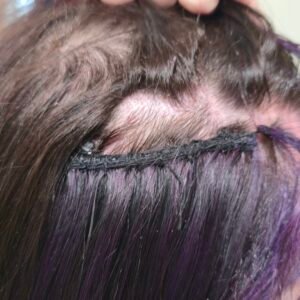
I currently wear Natural Beaded Rows (NBR).
Here’s how it works:
-
Your stylist creates a track using tiny aluminum micro beads and thread
-
Hand-tied wefts (panels of hair) are sewn onto that track
-
No glue
-
No tape
-
No heat touching your natural hair
When I started, my natural hair length was just above my shoulders so we started with 2 rows. Two years later, I’m currently wearing one row. And here’s why this works for fine hair:
The weight is distributed evenly across the entire track.
It’s not pulling on one tiny bundle of strands. And that matters more than most people realize.
The Upside
-
Incredible volume
-
Natural movement
-
Ponytails are still possible
-
No bulky attachment points
The Reality Check
-
It’s an investment
-
Maintenance every 6–8 weeks (I go every 8)
-
The first day or two after install or move-up? You’ll feel them. That passes.
-
If you choose a vivid color (like my purple), changing it later is not simple. Ask me how I know.
I didn’t get extensions because I hated my hair. I got them because my fine texture would get stringy when it grew longer. I’d never experienced long hair in my life and this to me was the least damaging way to do it.
Tape-Ins: Possible, But Be Careful
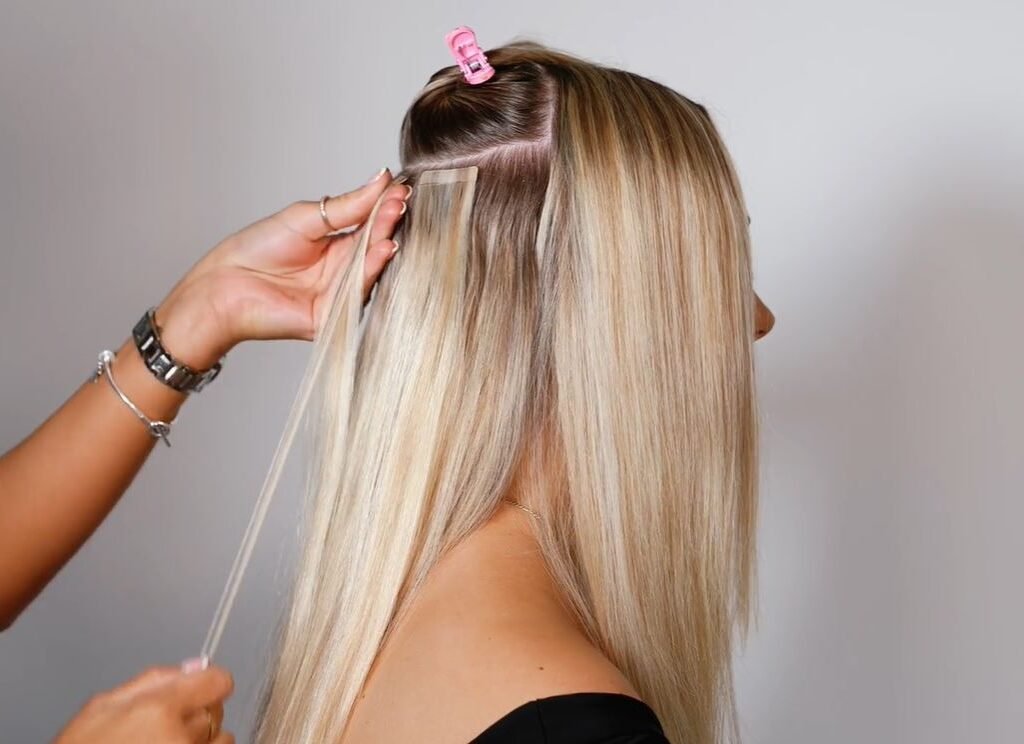
Tape-ins use thin wefts attached by sandwiching your hair between adhesive tabs.
They lie flat. That’s good for fine hair.
The Upside
-
Lightweight
-
Faster application
-
Virtually invisible when worn down
The Concerns
-
Adhesive can break down (especially with oils)
-
Still attached to small sections of hair
-
Must be removed professionally
-
You generally can’t wear your hair up
If you’re okay wearing your hair down most of the time, this can work.
But if your hair is very fragile, I’d proceed thoughtfully.
Clip-Ins & Halos: Low Commitment
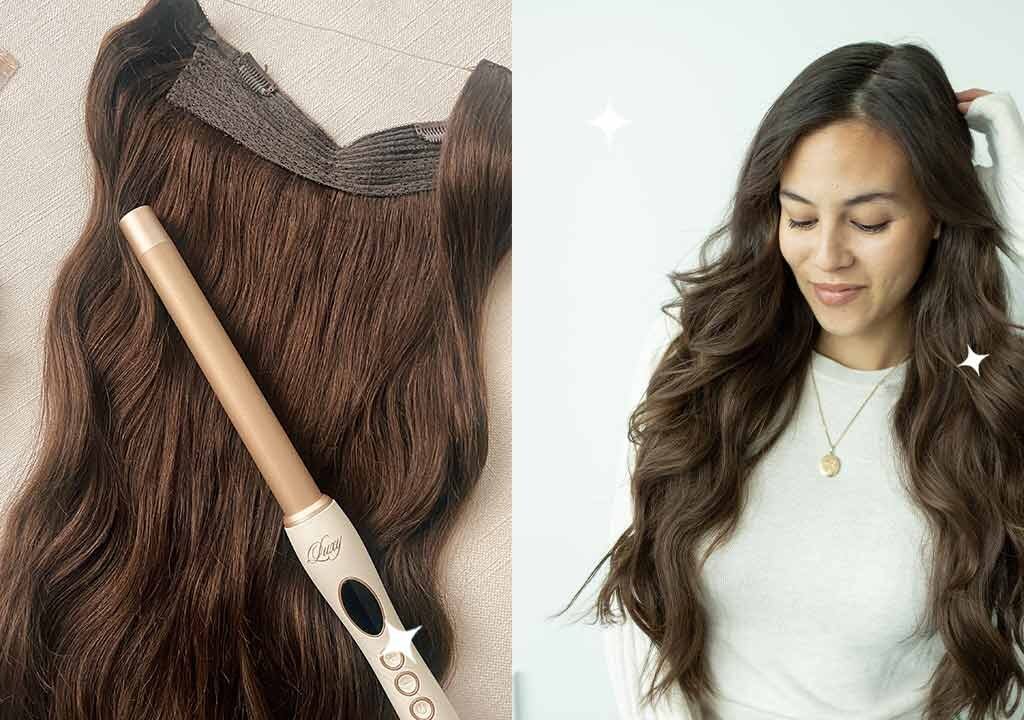
Clip-ins and halo extensions are your “no commitment” options.
Clip-ins: Small wefts you attach with clips.
Halo: A weft on a clear wire that sits on your head, with your hair pulled over it.
The Upside
-
Zero long-term damage if used correctly
-
Great for events
-
Good way to test how fuller hair feels
The Downside
-
Not wake-up-and-go
-
Daily install and removal
-
Can feel like “one more thing”
I knew myself well enough to know I wouldn’t consistently use clip-ins. Personality matters here.
Methods I Would Be Very Cautious About
Keratin Bond / Fusion Extensions
Strand-by-strand. Heat-applied adhesive.
All the weight sits on a tiny section of your hair. Over time? That’s stress.
Removal involves chemical bond removers that can be harsh. Some stylists even wear masks during certain treatments because of fumes.
For already thinning hair, I personally would not risk it.
Micro Links / I-Tips
Also strand-by-strand, but clamped with beads instead of glue.
Same issue:
All the weight pulling on a small section.
If you lack density, this can create a stringy look. Not the goal.
Traditional Sew-In Weaves
Natural hair braided tightly into cornrows, wefts sewn on top.
The tension risk here is real — especially for fine hair.
Traction alopecia (hair loss from tension) can become permanent.
That’s not a gamble I’m willing to take.
Let’s Talk Money (Because We’re Adults)
This is not a casual beauty purchase.
Using NBR as an example:
Initial Investment
Includes:
-
The hair
-
Custom color matching (your hair + extension hair)
-
Installation
-
Cut and styling
Expect $1,300–$3,000+ depending on the area you live in & how many rows you have installed.
Yes. It’s a big number.
Plan on several hours in the salon chair. Pack snacks.
Maintenance
Every 6–8 weeks.
Non-negotiable.
Move-ups typically start around $300+, depending on:
-
Rows
-
Color refresh
-
Stylist expertise
This is not a one-and-done expense. It becomes part of your recurring beauty budget.
When I first heard the numbers, I had to sit with it. For me, the joy of long hair made it worth it. But that’s a personal choice.
Be honest with yourself before you commit.
Hair Quality Matters (A Lot)
Look for:
-
Remy human hair – cuticles aligned in one direction (less tangling)
-
Virgin hair – Remy hair that hasn’t been processed (highest quality, most expensive)
Cheap hair costs more in the long run. It tangles. It sheds. It frustrates.
This is not the place to bargain hunt.
Choosing Your Stylist Is Everything (seriously)
This is the most critical decision in the entire process.
Do not look for a deal.
Do not use a Groupon.
Do not go to someone “still learning.”
You need an expert.
What to Look For
-
Proper certification (especially for NBR)
-
Portfolio showing fine or thinning hair clients
-
Thorough consultation
-
Transparent, itemized pricing
-
Clear maintenance plan
Ask:
-
How long have you been certified?
-
Can I see clients with hair like mine?
-
What brand of hair do you use?
-
What does each move-up cost?
If they’re vague or dismissive, walk away. The right stylist makes you feel cared for. Not pressured.
The Day-to-Day Reality
Transitioning Off Extensions (Gracefully)
If you decide to stop:
-
Professional removal only. Do not DIY this.
-
Expect “hair shock.” Your hair will feel dramatically thinner. It’s mental recalibration.
-
Get a fresh haircut.
-
Focus on scalp and hair support.
-
Be patient.
You didn’t suddenly lose more hair. You just got used to having more. That adjustment period is normal.
So… Are Extensions Worth It After 50?
They can be.
But only if you approach them as a serious investment in:
-
The right method
-
The right stylist
-
The right maintenance
-
The right expectations
For me? It’s been positive. I’ve loved experiencing long hair. It gave me a confidence boost I didn’t realize I was missing.
But it’s deeply personal.
This isn’t about chasing youth.
It’s about expanding options.
And at this stage of life, we choose intentionally.
Watch the Full Conversation
If you’re considering hair extensions and trying to decide whether they’re actually worth it for thinning hair after 50, the full video walks through everything in more detail — including what my own extensions look like, how they’re installed, and what maintenance realistically looks like.
I also show you the track from my Natural Beaded Rows (NBR) extensions, talk through the real costs, and explain the daily care that keeps your natural hair protected.
Because honestly, this is one of those topics where seeing it makes a big difference.
You can watch the full conversation here:
🎥 Watch the full video:
Are Hair Extensions Worth It for Thinning Hair After 50?
Affiliate Disclosure
This article may contain affiliate links. If you purchase through one of these links, I may earn a small commission at no additional cost to you.
I only recommend products and tools that I genuinely believe are worth your time and money and that align with a thoughtful, pro-aging approach to beauty.
As an Amazon Associate, I earn from qualifying purchases.
Affiliate partnerships help support the time and research that goes into creating Beauty with AS content, and I’m grateful you’re here.